
Assessing pavement construction and material composition
Coring is the process of drilling cylindrical samples (cores) from an existing pavement structure — whether asphalt, concrete, or composite — to examine, test, and evaluate the materials and layer structure of the pavement. It is a standard and essential practice in pavement investigation, quality control, and rehabilitation design.
We deliver all aspects of highways and utility coring, and we have significant plant and labour resources available. We maximise safety, efficiency and quality of service, fulfilling client needs by providing clarity of performance and responsibility, value for money, and contract control.
All the information gathered during on site investigations is analysed in our materials testing laboratory to provide clients with detailed and accurate pavement reports and asset management insights.
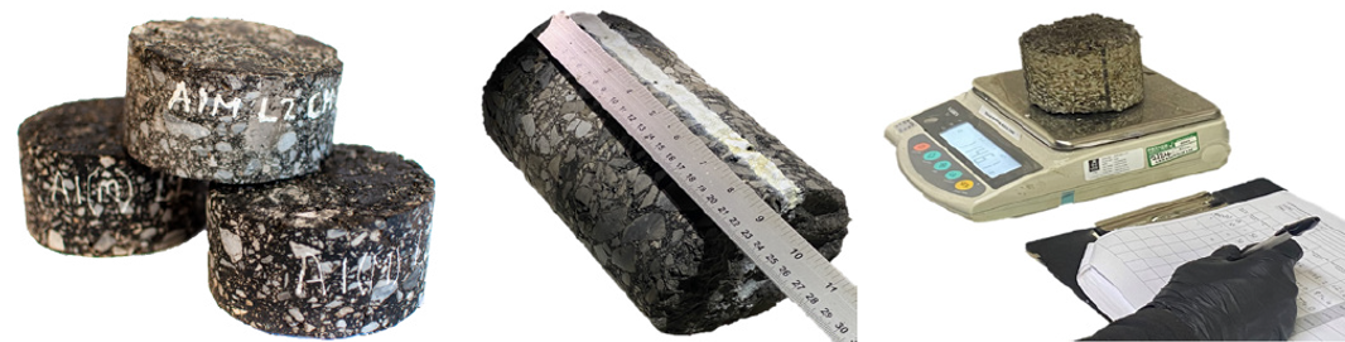
Prior to site works, we refer to best practice guidance when determining the number of samples required and we pre-inspect each site to determine any site-specific features that may impact on works such as bus stops, parking bays, schools, traffic speed and volumes, working hours restrictions, forward visibility for road users, and local business access requirements. We will work with you and other stakeholders to minimise disruption to road users.
Pavement Coring
We drill, reinstate, log, and analyse over 10,000 pavement core samples annually and we are capable of drilling to 1m in depth through bituminous and cementitious layers with core barrel diameters of 100mm, 150mm, 200mm and 300mm.
Operatives use tailored mobile data capture systems to record details on site including accurate locational / GPS co-ordinate information and high-quality photographs of the core extraction process. Ground bearing capacity and the California Bearing Ration (CBR) can be determined by Dynamic Cone Penetrometer (DCP) testing.
We also deliver tar testing in the form of PAK-Marker and PAH testing, which is undertaken in-house to ensure a comprehensive pavement evaluation is undertaken in a timely fashion.

Utility Coring
Utility coring is becoming increasingly important in utility management and contractor performance monitoring, and we deliver utility coring programmes for a variety of clients. For each batch of cores reported, a summary report will be provided including an overall performance summary and broken down by each utility, setting out the number and percentage of carriageway and footway cores which passed and failed at each testing stage. Utility testing includes:
- Visual assessment of the utility reinstatement with photos provided
- Determination of bulk density, maximum density, and air void percentage of samples
- Depth pass / fail
- Air void pass / fail

Unbound Material Sampling (UMS)
Building strong foundations starts with the right materials and Unbound Material Sampling (UMS) is the process of collecting and testing materials not bound by cement, bitumen, or other binding agents — such as gravel, crushed rock, sand, and soil — to assess their suitability for construction. UMS plays a crucial role in ensuring the performance, durability, and safety of roads, pavements, and other civil engineering structures.
Our UMS procedures are carried out in accordance with BS 5930:2015 – Code of Practice for Ground Investigations and IAN 73/06, Section 4 – Draft Design Standard HD 25: Pavement Foundations. UMS applications include:
- Quality Assurance – confirming that delivered or placed materials meet the required project specifications
- Design Confidence – verifying that materials have the strength and stiffness needed for long-term performance
- Regulatory Compliance – demonstrating adherence to key standards including BS EN 932, BS EN 1097, and ASTM D75 for aggregate sampling.
SPACER


Delivering service enhancements
Core and unbound material sampling allows engineers and contractors to analyse the physical, chemical, and structural properties of tested pavements and subgrade materials, with standard reporting traditionally consisting of site plans, tabular reporting, and photographs.
Through an innovative approach we have implemented an interactive cloud-based system, allowing clients to access data results on any licensed device and in any location. Our XA© suite of software is GIS-based, and delivers spatial analysis and mapping of coring and UMS results in as near real-time as possible.
Our clients are able to:
- Visualise sample locations on interactive maps, improving spatial understanding of conditions
- Identify trends and inconsistencies across the network, e.g. if tar-bound material is found in one location, adjacent road sections can be flagged as areas for further investigation
- Integrate sample data with other infrastructure datasets, providing a holistic view of asset conditions
- Export GIS-compatible reports for further analysis, ensuring compatibility with client systems
- Correlate test results with environmental factors such as weather patterns to understand how flooding is affecting the tested locations
- Apply topographical analysis tools to predict asset degradation over time
SPACER

Why choose XAIS-PTS?
At XAIS-PTS our team has a wealth of experience, and we deliver comprehensive pavement investigations across major infrastructure. We also deliver a wide variety of asset management surveys, software, professional services, programme development & design and materials testing services.
If you have any questions or queries about our services, please contact us today – our team will be more than happy to have a conversation with you regarding your project requirements!